
How Often Should You Max Hang?
 PK
PKPeter Klimek
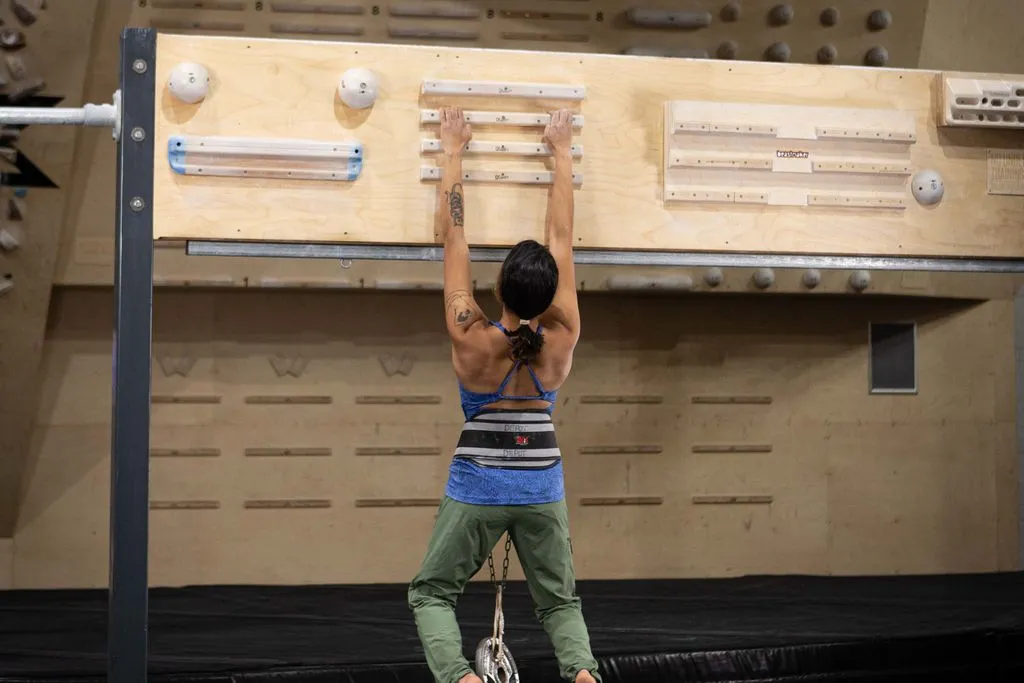
This is the first in a Q&A series where we take questions we've received from users over the years and answer them with data. We get a lot of the same questions — about training frequency, exercise selection, how to balance different types of training — and many of them deserve longer answers than a support email allows. This series is where we'll work through those questions and look more closely at the data behind some of the most commonly debated topics in climbing training. If you have a question for future blog posts, shoot us an email.
Q: What is the appropriate number of Max Hang sessions per week? How should Max Hang training be balanced with other training volume?
The Max Hang dose-response is the clearest and strongest signal of any training variable in our dataset — a clean, monotonically increasing curve with no sign of plateau within the observed range.
But the frequency question turns out to be the less interesting half of the story. What you do between Max Hang sessions matters more than how many you do.
Here's what 24,695 assessment windows from the Crimpd database show.
The dose-response curve
We grouped users by Max Hang session frequency (sessions per week) across their assessment window and looked at mean change in strength-to-weight ratio (Delta S:W).
| Frequency | n | Mean Delta S:W | SD |
|---|---|---|---|
| None | 5,490 | +2.20 | 6.93 |
| 0.01–0.25/wk | 2,641 | +1.89 | 7.27 |
| 0.25–0.5/wk | 3,108 | +2.63 | 7.01 |
| 0.5–1.0/wk | 5,975 | +3.79 | 5.98 |
| 1.0–1.5/wk | 3,918 | +4.67 | 5.71 |
| 1.5–2.0/wk | 1,348 | +4.99 | 5.55 |
| 2.0–3.0/wk | 870 | +5.26 | 5.62 |
| 3.0–4.0/wk | 222 | +5.67 | 5.94 |
| 4.0–5.0/wk | 66 | +6.07 | 6.37 |
| 5.0+/wk | 57 | +5.74 | 5.57 |
A few things stand out.
Below 0.5 sessions per week, Max Hangs don't do much. The 0.01–0.25/wk group — users who logged a Max Hang session roughly once a month — gained less than users who did no Max Hangs at all (+1.89 vs +2.20). That's likely a selection effect: people who try Max Hangs once and stop aren't a representative sample. But the takeaway holds — sporadic Max Hangs aren't worth the time.
The jump at 0.5–1.0/wk is the biggest step in the curve. Going from less-than-biweekly to roughly once a week adds +1.16 to Delta S:W. No other frequency increment produces that large a gain. Once-a-week Max Hangs are meaningfully better than nothing.
1–2 sessions per week is the sweet spot for most people. Gains of +4.67 at 1–1.5/wk and +4.99 at 1.5–2/wk, backed by solid sample sizes (3,918 and 1,348 respectively). Going from 1/wk to 2/wk adds roughly +1.2 points — still a worthwhile return.
Above 3/wk, returns flatten. Gains continue — +5.67 at 3–4/wk, +6.07 at 4–5/wk — but sample sizes drop below 250 and the increments shrink. There's a possible dip at 5+/wk (+5.74), though at n=57 that's noise.
If this were the whole story, the recommendation would be straightforward: 1–2 sessions per week. But the more interesting finding is what happens when you factor in total training volume.
What you do between sessions matters
Among users who met the 0.5/wk minimum for Max Hangs, we split by total training volume — all logged sessions, not just Max Hangs. The median was 2.28 sessions per week.
| MH Frequency | Low Volume (≤2.3/wk) | High Volume (>2.3/wk) | ||
|---|---|---|---|---|
| n | Mean Δ S:W | n | Mean Δ S:W | |
| 0.5–1.0/wk | 3,013 | +4.43 | 2,962 | +3.13 |
| 1.0–2.0/wk | 2,622 | +5.36 | 2,644 | +4.15 |
| 2.0–3.0/wk | 439 | +6.03 | 431 | +4.48 |
| 3.0+/wk | 171 | +6.39 | 174 | +5.14 |
At every Max Hang frequency, users with lower total training volume gained more. The gap is consistent: 1.2–1.6 points of Delta S:W, regardless of how often they did Max Hangs.
This isn't because lower-volume users started weaker — total volume correlates weakly with baseline strength in this dataset. It looks like a genuine recovery effect. Users doing Max Hangs on top of a heavy training load got less out of those sessions than users who kept the rest of their schedule lighter.
The proportion analysis makes this even clearer.
| MH as % of Total Training | n | Mean Δ S:W | Avg MH/wk | Avg Total/wk |
|---|---|---|---|---|
| <10% | 879 | +2.58 | 0.8/wk | 11.1/wk |
| 10–25% | 2,862 | +3.40 | 0.9/wk | 5.4/wk |
| 25–50% | 3,034 | +4.16 | 1.0/wk | 2.9/wk |
| 50–75% | 1,751 | +4.55 | 1.1/wk | 1.9/wk |
| >75% | 3,930 | +5.50 | 1.5/wk | 1.0/wk |
The two extremes tell the story. Users whose training was >75% Max Hangs averaged 1.5 sessions per week with almost nothing else. Users at <10% averaged 0.8 Max Hang sessions buried inside 11.1 total weekly sessions. The >75% group gained +5.50. The <10% group gained +2.58. Nearly three points of difference — and the two groups did roughly similar amounts of actual Max Hangs.
The difference is recovery. The >75% group gave their fingers maximal rest between sessions. The <10% group stacked Max Hangs on top of a full training schedule and got less out of them.
What this means
The frequency answer is clean: 1–2 Max Hang sessions per week. Below 0.5/wk there's no measurable benefit. Above 3/wk the returns diminish faster than the effort scales.
The volume finding matters more. If you're already training 4+ sessions per week and adding Max Hangs on top, the data suggests you'd get more out of those Max Hangs by doing less of the other stuff — not because the other training is bad, but because your fingers aren't recovering enough between sessions to get the full adaptation.
This is the strongest signal in the dataset for quality over quantity in finger strength training. Max Hangs work best as the focus of a training block, not as an add-on to an already packed schedule.
-pk
About the author
PKPeter Klimek
Co-founder & Developer
Peter is the co-founder of Crimpd and the CTO of Lattice Training. He builds training tools for climbers who want to get stronger without guesswork. When he's not working, he can be found building trails and developing new boulders in the Pacific Northwest.